
Ana Maria is 20 years and falls in love extremely fast and intense, just like any other teenager. For her birthday she wore a red dress, long and with a bare shoulder along with some discreet pieces of jewelry.
Probably because of the dress, or probably because her parents told her „Ana, from now on you are a grown-up!”, probably because all the people who love her gathered together and told her how beautiful and elegant she was, or probably because of all of the above, the day Ana turned 18 was the most beautiful day of Ana’s life.
She now dreams of another day: the day when she will get married, a moment that she wants to celebrate by wearing a long white dress and a princess tiara.
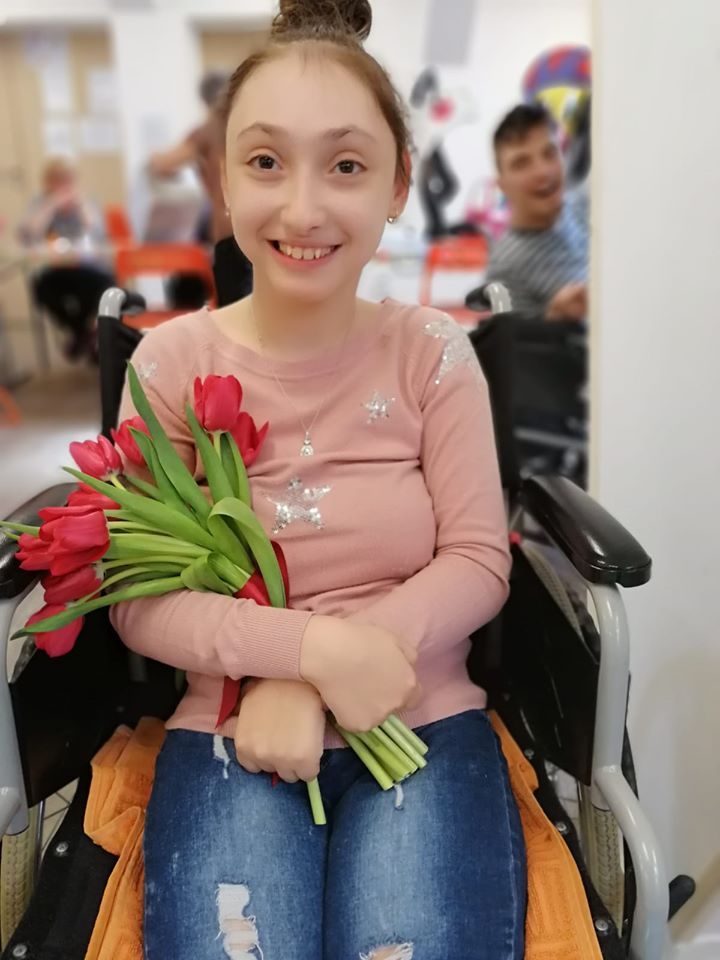
A happy child
Ana is interested in relationships not for her in particular, but for the others around her. When she meets someone new from HOSPICE, she asks a lot of questions and: „Are you married?” is a headliner every time. At some point, a nurse from HOSPICE answered that she wasn’t married and Ana turned right into Cupid by saying: „Miss, X is not married either”. Then she laughed. She always laughs, with all of her strength, although she is confined in her wheelchair. There are a lot to be said about the dignity, strength and determination that this child bears her diagnostic chart with. But beyond the harshness of life, she fights her illness with joy.
If she is grumpy, she is nervous, not upset. And when she is extremely happy she cannot control herself so she laughs continuously. Simona, the HOSPICE paediatrics day centre coordinator, describes Ana as „a special child, warm and kind, a happy child that has a great social need. She loves people, she loves talking to them, analyzing and knowing things. When she finished her 10th grade and was not allowed to attend school anymore, both she and her parents were very upset, as she hates staying at home. She wakes up early and says: „Come on, are we going to HOSPICE today?”
If you ask her about her fears, Ana is not afraid of anything. There is something she hates, though – „to see people cry, to see another sufferring besides her own.” Ana and the patients sufferring from harsh diagnostics do not need our tears and grieving. They have their own. However, they need to know that they belong to a responsible community, properly trained to offer them care and education.
Diagnostics
When Ana was one year and two months old, Cristina and Marius, her parents, found out the first diagnostic of their daughter: spastic tetraparesis. For Cristina, the State owned sanitary system is the greatest disappointment, not because there are no specialists, but because some of them lack the understanding, the humanity, the compassion in relationship with the patients.
„We didn’t know what this cursed spastic tetraparesis was, and the doctor told me that I’d rather let my child die, because she will be a vegetable all her life and we will not get along with her. But look at her. It wasn’t the case.” They started the therapy immediately: one week in the therapy centres, one week at home and so on. One year later, surgery followed. Ana had to take so many surgeries in Romania and in Chişinău that her parents lost track of their numbers. Ana jokes about her surgeries saying that „they cut me like a cabbage”. It looks simple when you hear her speak. It is not. But this is how she wants to talk about her problems and it makes the fight seem like an easy task for anyone.
Until she was 10 she managed to walk on her own feet, but the strong epilepsy crisis confided her into her wheelchair again. „She made significant progresses and her evolution was fantastic, but then the epilepsy crisis began and proved to be a major setback. However, Ana has a strong will. Her will was stronger than the setback”, her mother tells us.
Today, at the HOSPICE hospital next to Plumbuita Lake, the paper butterflies catch different colours in Ana’s hands. She tells stories and poems, she knows anything there is to know about teenagers music and she makes a lot of plans. Because of the physiotherapy sessions, if someone lifts her from her wheelchair and supports her back, Ana can even dance.
Bureaucracy: Romania’s incurable illness
Besides Ana’s incurable diagnostics, Cristina says that the whole Romania suffers from an incurable illness: bureaucracy. She was forced to fill dozens of papers, files and controls and had to face dozens of boards and committees so that Ana can benefit from 340 lei/month as financial support and disability pension. For the last one she has to put together the same documents year after year, as if in the last 12 months Ana had miraculously cured from an illness that has no cure.
Her second home
When HOSPICE inaugurated in Bucharest the paediatrics services, Ana and her mother were among the first patients receiving free care. „This is just like Ana’s second home. She has friends, there is a community, she feels love and enjoys her childhood. And this place is not only for Ana, it is for us, the parents, as well, because we talk one to the other, we help each other, we share advices, we have counselling sessions”, Cristina tells us.
She finds a few scenes of normality in HOSPICE and receives support to fight and not be overwhelmed when others give up. And Ana asks the same question every day: „Are we going to HOSPICE today?”.
Only in Bucharest and the surrounding areas, there are approximately 5.000 children affected by life-limiting illnesses. In total, every year in Romania there are more than 170.000 patients that need support to fight an incurable illness, but only 9% of these patients have access to palliative care services in order to spend their last days with dignity and in peace along their beloved ones.
HOSPICE Casa Speranţei is among the non-profit organizations that can be supported by redirecting 3,5% of the income tax from last year. It is a small gesture that can bring comfort to great pains. It does not involve any cost but it means a lot to those who need our support in the toughest battle of their lives. Offer your support, because small gestures turn into great deeds! Visit us on https://www.hospice.ro/3punct5hospice/ and download the ANAF form or access it here. The deadline to complete and submit the 230 form is the 15th of March 2020.