
 The critical minerals behind renewable energy
Every wind turbine, solar panel, and electric vehicle battery on earth begins in the exact same place: a mine.
While the transition to renewable energy is frequently celebrated as a triumph of high-tech digital innovation, its ultimate success relies on something far more primal: critical minerals. Unlike fossil-fuel systems that run on combustible hydrocarbons, clean energy infrastructures are fundamentally mineral-intensive. They require massive volumes of metals and elements to generate, store, and distribute electricity.
As global grids and vehicle fleets electrify at breakneck speed, understanding the material supply chains powering this shift is becoming just as vital as understanding the technologies themselves.
 Renewable energy is mineral intensive
Building a decarbonized world requires an exponentially larger volume of raw physical inputs than our current fossil-fuel baseline. The contrast, when mapped out by the International Energy Agency (IEA), is stark.
For example, a typical EV demands roughly six times the total critical mineral input of a standard internal combustion engine car.
 Copper is the backbone of electrification
If the energy transition has a single indispensable asset, it is copper.
Thanks to its unmatched electrical conductivity and relative abundance, copper serves as the literal “connective tissue” of the new energy economy. It is woven into everything from wind turbine generators and solar photovoltaic arrays to the millions of miles of new transmission lines and transformers required to overhaul global grids.
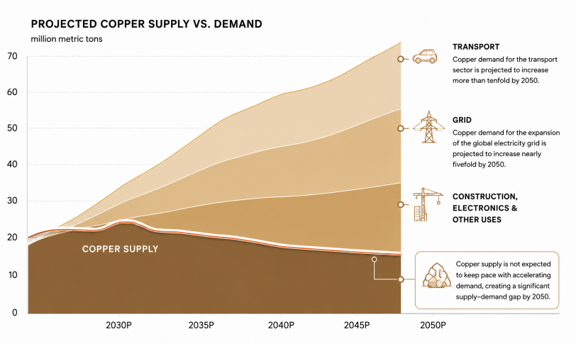 The volume king: The IEA expects copper to experience the largest increase in absolute demand of any critical mineral through 2040. Because its pre-existing global market is already massive, even modest percentage growth translates to millions of additional physical tons, cementing its status as one of the most strategically vital commodities of the coming decades.
The battery trio: lithium, nickel, and graphite
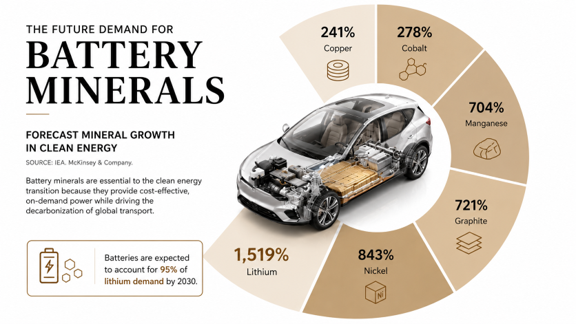
Generating clean electrons is only half the battle. Because wind and solar are inherently intermittent, large-scale energy storage is non-negotiable for keeping the lights on 24/7. This reality is driving unprecedented demand for a specific trio of battery materials:
- Lithium: The undisputed chemical foundation of modern lightweight, high-capacity rechargeable batteries.
- Nickel: The crucial ingredient used to boost energy density.
- Graphite: The quiet workhorse that comprises the battery’s anode. Surprisingly, a standard lithium-ion battery contains more graphite by weight than lithium, making it one of the most underappreciated bottlenecks in the clean-tech pipeline.
Other minerals, including cobalt and manganese, also play important roles in specific battery chemistries, although advances in battery technology are steadily reducing reliance on cobalt in many applications.

Precision performance: rare earths and silver
While bulk metals dominate the headlines, several specialized materials play smaller, hyper-critical roles in maximizing system efficiencies:
- Rare Earth Elements: Materials like neodymium and praseodymium are vital for manufacturing the powerful permanent magnets found inside high-efficiency wind turbines and EV drivetrains.
- Silver: Boasting the highest electrical conductivity of any element, silver is essential for the conductive pastes within solar PV cells. This dependency has turned solar manufacturing into one of the fastest-accelerating drivers of industrial silver consumption worldwide.
Growing demand meets constrained supply
The defining feature of today’s critical minerals market is not demand alone, but the widening gap between demand growth and supply expansion.
Bringing a new mine from initial discovery to commercial production is a notoriously slow endeavor, often requiring more than a decade to reach production. Timelines are routinely dragged out by localized permitting friction, rigorous environmental reviews, and deteriorating ore grades at mature sites.
Combined with high geographic concentration, where a handful of nations control the vast majority of processing and extraction, the world is facing a structural mismatch. Demand is being accelerated by ambitious government mandates, but supply simply cannot pivot at the same speed.
Investor takeaway
The renewable energy revolution is doing far more than altering how we generate electricity, it is fundamentally rewiring global commodity markets.
For long-term investors, the clean energy transition is becoming less a question of technological innovation and more one of resource availability. As demand for electrification accelerates, the companies responsible for discovering, mining, and processing critical minerals are becoming increasingly central to the entire value chain.