As technology continues to reshape careers and work culture, the workplace is set for major change in the second half of the decade. Staying ahead means understanding the trends driving this transformation. In 2026, AI plays an even greater role in the work lives. Equally important is recognizing the areas where human skills and judgment remain indispensable, alongside learning to leverage these powerful tools effectively. In 2026, employees and companies call for a more balanced, thoughtful approach.
The key question: Which are the improvements and transformations brought by 2026 in the workplace culture?
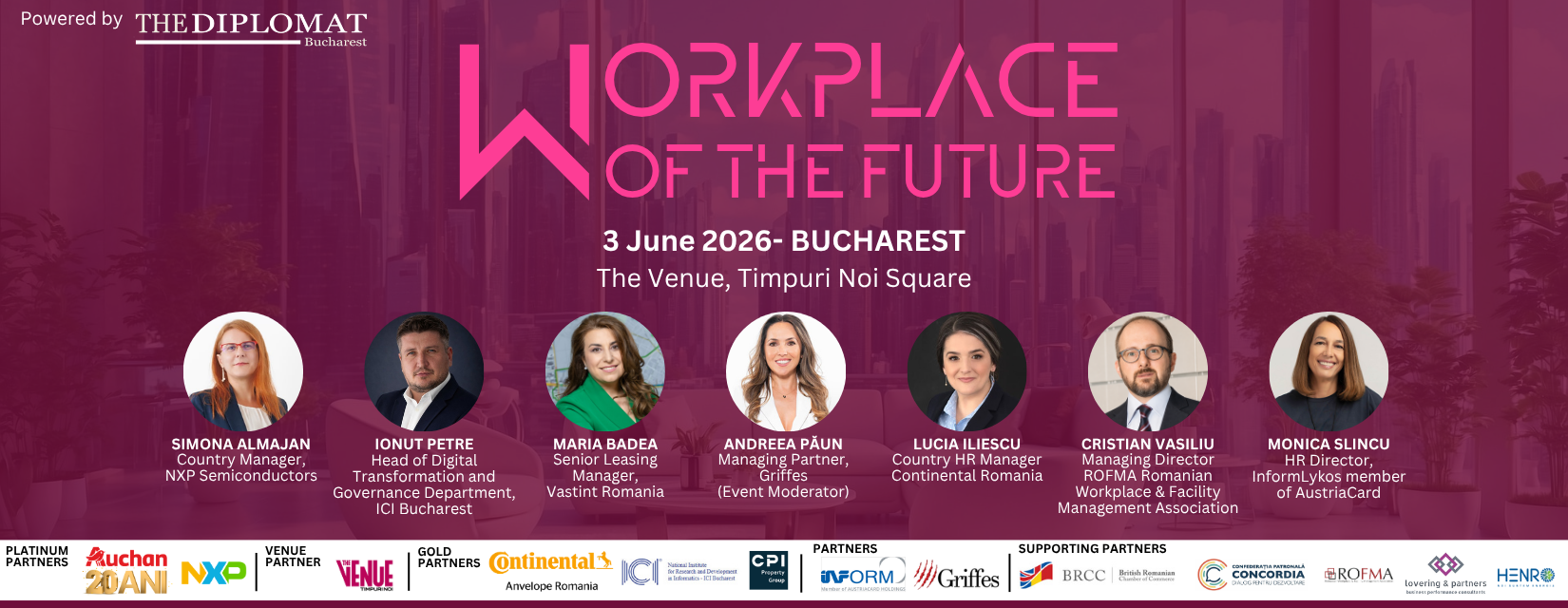
The Diplomat – Bucharest is organizing the 10th edition of WORKPLACE OF THE FUTURE, to be held at Timpuri Noi Square, on June 3, a conference dedicated to the workplace evolution and continuous adjusting trends.
EVENT Agenda:
9:00 – 10:00 Registration & Coffee
10:00 – 12:00 Conference discussions
- AI at Work
- Workplaces as Connected Ecosystems
- The Transformation of Jobs and Ways of Working
- The New Office
12:00 – 13:00 Networking & Lunch
AI at Work
Until recently, many organizations treated AI as an add-on—tools to automate or streamline existing processes, such as analytics platforms for business data or chatbots for onboarding new hires. The next evolution will be AI-native workflows, designed from the ground up to harness automation, predictive insights, and data-driven decision-making. Examples could include supply chains that automatically adjust to real-time shifts in demand or disruptions, or manufacturing systems that adapt dynamically to customer orders and material availability.
- The way AI-native workflows improve efficiency in the companies
- Processes that benefit most from predictive insights
- Risks that arise when relying heavily on automated decision-making
Workplaces as Connected Ecosystems
With hybrid and remote work now embedded in most company cultures, workplaces are evolving into flexible ecosystems of tools, communication networks, and physical spaces that support employees wherever they are. Whether at home, in offices, co-working hubs, or immersive virtual environments, the focus is on creating a seamless employee experience. For companies, this ensures operational continuity and access to global talent; for workers, it allows professional responsibilities to fit around personal lives while maintaining a connection to organizational culture.
- Securing seamless experience for remote and hybrid workers
- Tools that best support collaboration across multiple locations
- Balancing the flexibility with preserving the company culture
The Transformation of Jobs and Ways of Working
Technology’s impact on jobs is undeniable, leading to reductions in hiring for certain roles—particularly entry-level positions in clerical, administrative, and data-entry fields, as well as some middle-management roles. At the same time, other sectors, including nursing, caregiving, construction, education, and technology, are experiencing growth. Graduates, early-career professionals, and older workers seeking career changes will need to consider these shifts carefully when making career decisions in 2026.
- Roles that are likely to shrink or grow
- Upskilling and reskilling for preserving and grow relevance in the company and business
- Strategies to manage career transitions effectively
The New Office
By 2026, the workplace is increasingly defined not by a single location but by flexibility, connectivity, and employee experience. Hybrid and remote work models have become the norm, supported by seamless digital collaboration tools, cloud-based systems, and immersive virtual environments that allow teams to operate efficiently from anywhere. Physical offices are evolving into hubs for creativity, collaboration, and social connection rather than purely task-based spaces, while co-working spaces and flexible office arrangements offer additional adaptability. This new ecosystem prioritizes outcomes over hours spent on-site, emphasizes work-life integration, and reflects a culture where employees have more autonomy in how, when, and where they work, all while maintaining alignment with organizational goals and community.
- Redesign of office spaces for a better collaboration and creativity
- Digital tools to enhance productivity in hybrid or remote settings
- Measuring outcomes and tools to assess performance